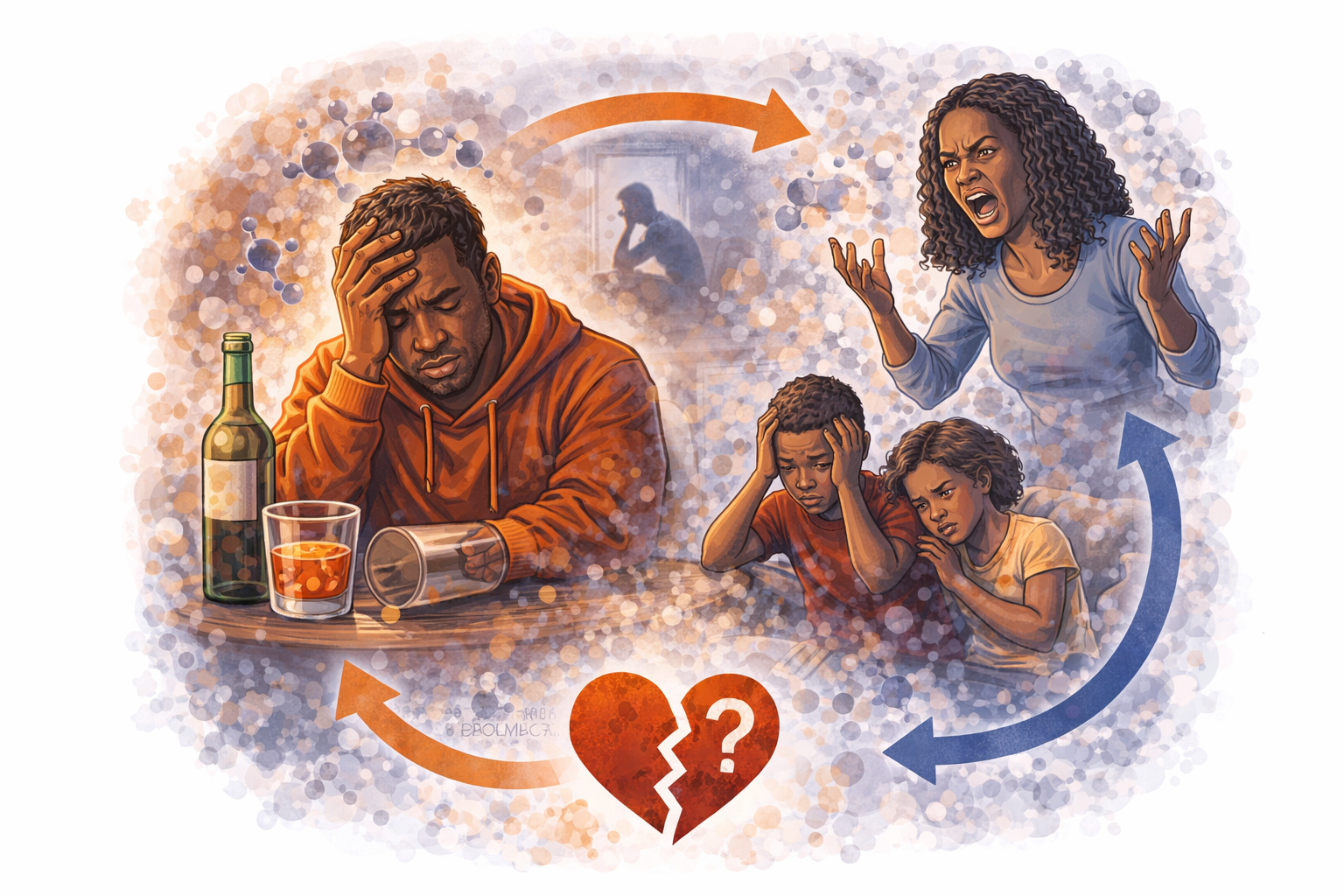
Alcohol Use Disorder does not only affect the individual—it often has a significant impact on family members and close relationships. Addiction can change communication patterns, emotional connections, and the overall stability of a household.
Family members may experience confusion, frustration, and emotional distress as they try to understand the person’s behavior. They may struggle with questions such as, “Why can’t they stop?” or “What can I do to help?”
Over time, relationships may become strained due to broken trust, inconsistent behavior, or unmet responsibilities. Arguments may become more frequent, and communication may become less effective.
In some cases, family members may take on roles such as:
• Caregiver
• Problem-solver
• Protector
• Enabler
These roles often develop as a way to maintain stability, but they can also contribute to unhealthy dynamics.
Children in households affected by alcohol misuse may experience emotional instability, confusion, or anxiety. They may also develop their own coping patterns that can affect their future relationships and well-being.
It is important to recognize that family members are also impacted and may need support, education, and resources to navigate these challenges.
Recovery often involves rebuilding trust, improving communication, and creating healthier relationship patterns. With support, families can heal alongside the individual.

ShopTalk Therapeutic Services, LLC
Welcome! I’m Ty’Asia L. Jones, LICDC, MMFT, Founder and Chief Executive Officer of ShopTalk Therapeutic Services, LLC.
My passion is helping individuals, families, and communities recognize that mental health is life health. Throughout my career, I have dedicated myself to addressing mental health, substance use, trauma, and emotional wellness through education, advocacy, and evidence-based care.
I earned a Bachelor of Science from Central Michigan University, and a Master of Science in Education from The University of Akron, and a I am dually licensed in behavioral health and addictions, serving individuals across Ohio and Texas (pending), with specialized experience in co-occurring mental health and substance use disorders.
Beyond clinical practice, I am an author, researcher, speaker, entrepreneur, and mental health advocate. I have co-authored peer-reviewed research on substance use among refugee youth, published multiple scholarly works and eBooks, and continue developing resources that empower people to heal, grow, and thrive. I also create educational content through social media, YouTube, and community outreach to make quality mental health information accessible to everyone.
At ShopTalk Therapeutic Services, my mission is to eliminate the stigma surrounding mental health while expanding access to culturally responsive behavioral health services, education, and community programming. Whether through counseling, workshops, publications, or digital content, my goal is to equip people with practical tools to build healthier relationships, stronger families, and more fulfilling lives.
I believe healing begins with understanding, growth begins with courage, and lasting change begins with one conversation.
If it doesn’t make sense, it doesn’t belong in your life.
Thank you for visiting. I look forward to being part of your journey toward healing, resilience, and lasting wellness.
Leave a Reply